Testing
Testing
Unit tests and Integration tests
The unit and integration tests for the controller code are written using the
ginkgo and gomega testing frameworks. The tests are written in the
*_test.go files in the controllers directory.
By default, the tests are run against a single kubernetes api server(https://github.com/kubernetes-sigs/controller-runtime/tree/main/tools/setup-envtest ) provided by the controller-runtime project.
The test framework uses mock interfaces for the components that aren’t installed in the test environment, like ocm, s3 and csi. These mock interfaces are used to fake a success or failure from the components to test the controller code.
$ make test
hack/install-setup-envtest.sh
go test ./... -coverprofile cover.out
        github.com/ramendr/ramen/cmd    [no test files]
        github.com/ramendr/ramen/internal/controller/argocd [no test files]
        github.com/ramendr/ramen/internal/controller/kubeobjects    [no test files]
        github.com/ramendr/ramen/internal/controller/kubeobjects/velero [no test files]
ok      github.com/ramendr/ramen/internal/controller    72.451s coverage: 67.6% of statements
ok      github.com/ramendr/ramen/internal/controller/cel    6.190s  coverage:   [no statements]
ok      github.com/ramendr/ramen/internal/controller/util   6.387s  coverage: 19.9% of statements
ok      github.com/ramendr/ramen/internal/controller/volsync    19.654s coverage: 57.6% of statements
Explore other test- targets that test a subset of the controller code.
Coverage
The tests are run with coverage enabled. You can see the coverage report by running the coverage target.
To open an HTML coverage report in the default browser run:
make coverage
The coverage report depends on the tests ran before inspecting the coverage.
Using interfaces to mock in testing
It is always useful to run the unit or integration tests without setting up external dependencies. If the communication to the external components is done through interfaces, it becomes easy to mock those components by using a fake or mock implementation of those dependencies which satisfy those interfaces in the tests.
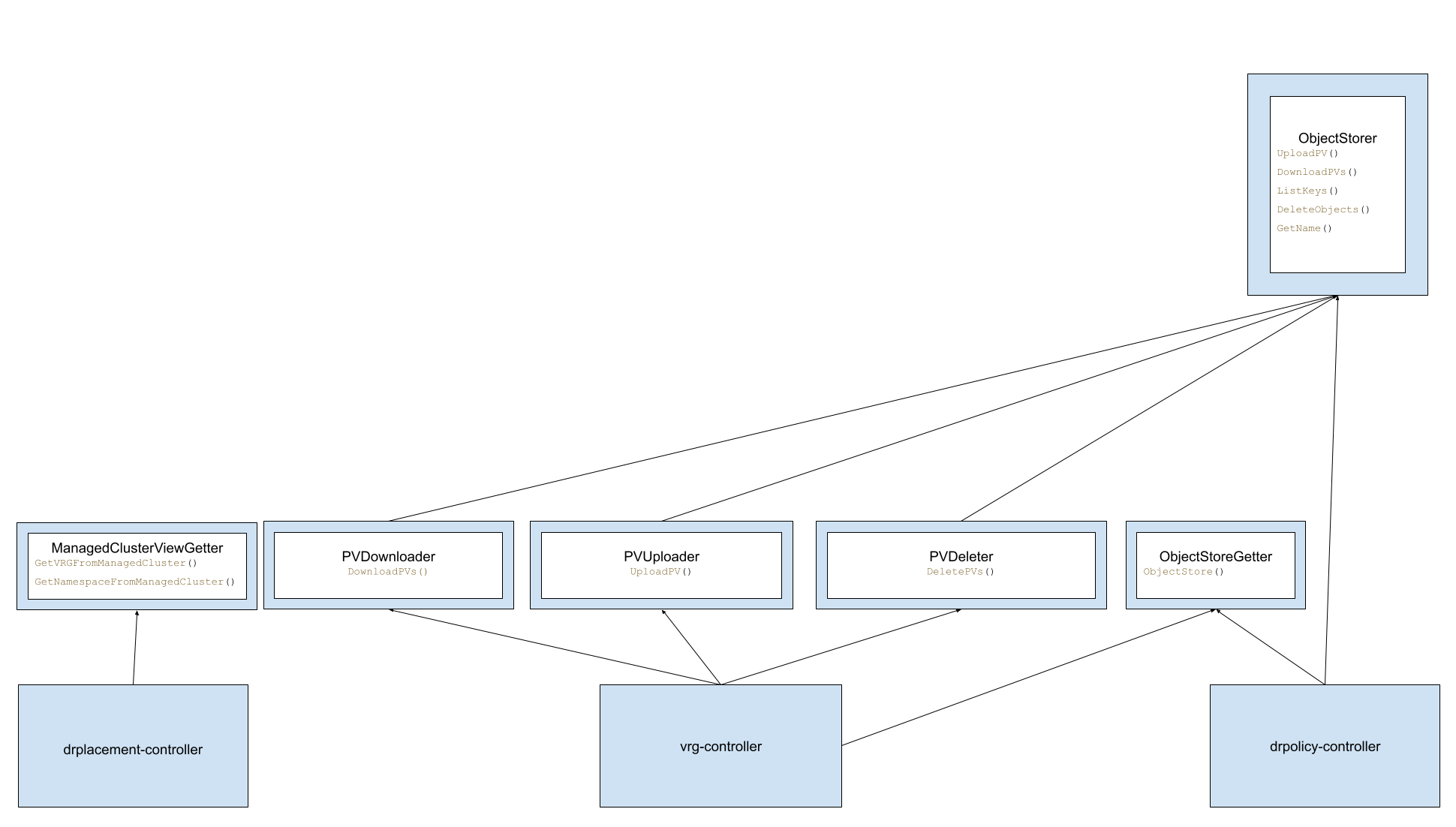
The above picture shows the interfaces that are used in Ramen today.
End-to-end tests
The end-to-end testing framework provides comprehensive testing capabilities for various DR scenarios using configurable workloads and deployment methods.
Please refer to the e2e testing documentation for detailed instructions.